Why New Coaches Struggle with Coaching Agreements (And How the TIBA Framework Changes That)
Coaching Agreements, ICF Core Competency 3, TIBA Coaching Framework, ACC PCC Coaching, Coach Training, Catalyst Coach Academy
The TIBA Coaching Framework: A Clear Path to Stronger Coaching Agreements
Why new coaches struggle with coaching agreements — and how the TIBA coaching framework can help you create focused, ICF-aligned sessions that truly move your clients forward.
By Ruthie Pérez Slingerland, MCC, Jamie Slingerland, MCC, and David Whitehead
You have spent years guiding others. As a leader, consultant, therapist, or mentor, you’re no stranger to deep conversations. People trust you. They seek you out. You know how to listen, how to ask thoughtful questions, and how to help them think things through.
And yet, when you step into the world of ICF coaching certification, something surprisingly simple starts to feel slippery: the coaching agreement. You hear about ICF Core Competency 3: Establishes and Maintains Agreements, you read the descriptions, and you might even pass a written quiz about it. But in real time, with a client in front of you, the agreement can feel vague, rushed, or overly scripted. It doesn’t quite land.
If that sounds familiar, you’re not alone. Many experienced professionals who are excellent communicators discover that coaching agreements ICF-style require a different kind of precision. That is exactly why we created the TIBA coaching framework at Catalyst Coach Academy: a simple, practical way to bring clarity and depth to your agreements without turning them into a rigid script.
The Silent Challenge: Why Coaching Agreements Trip Up New Coaches
Consider two common coaching scenarios you might recognize from your own practice, even if the names are different.
Scenario 1: A Vague Start with Good Intentions
Marta arrives at her session clearly overwhelmed. “Work has been crazy,” she says. “I’m juggling too many projects, and my team keeps coming to me with problems.” The coach listens empathetically and responds, “Okay, let’s talk about that. Tell me more about what’s been happening.” The conversation unfolds, touching on workload, delegation, time management, and a difficult colleague. The coach asks solid questions. Marta feels heard. But at the end, she says, “This was helpful… I just wish I knew what to focus on first.”
The coach did many things right. Yet the session feels flat — like it wandered instead of building toward something clear. If this were an ACC or PCC performance evaluation, the feedback would likely point to a weak or incomplete coaching agreement at the start of the session.
Scenario 2: A Focused Agreement that Changes the Conversation
Now imagine a similar situation with Diego. He also begins with, “Work has been crazy.” This time, the coach slows down the opening. “There sounds like a lot going on. If we think about just today’s session, what would you most like to leave with?” Diego reflects and says, “I want to decide how to handle one specific project that’s draining me.” The coach continues: “Great. What would make this conversation especially valuable for you regarding that project?” Diego answers, “Clarity about whether to push back on the timeline and how to talk to my manager about it.”
Already, the focus is sharper. The coach and client now have a shared target for the session. As they move forward, questions, reflections, and insights are all anchored to that agreed aim. At the end, Diego says, “I know exactly how I want to approach this conversation now.” The session feels purposeful, and the recording would likely meet ICF’s expectations for Core Competency 3.
“Most sessions that feel ‘flat’ don’t fail because of the questions — they fail because of a weak agreement at the start.”
What Is TIBA?
At Catalyst Coach Academy, we noticed that many talented new coaches understood the theory of coaching agreements but struggled to apply it consistently in real conversations. They didn’t need more jargon; they needed a simple, memorable structure they could carry in their minds while staying fully present with the client. That is how the TIBA coaching framework was born.
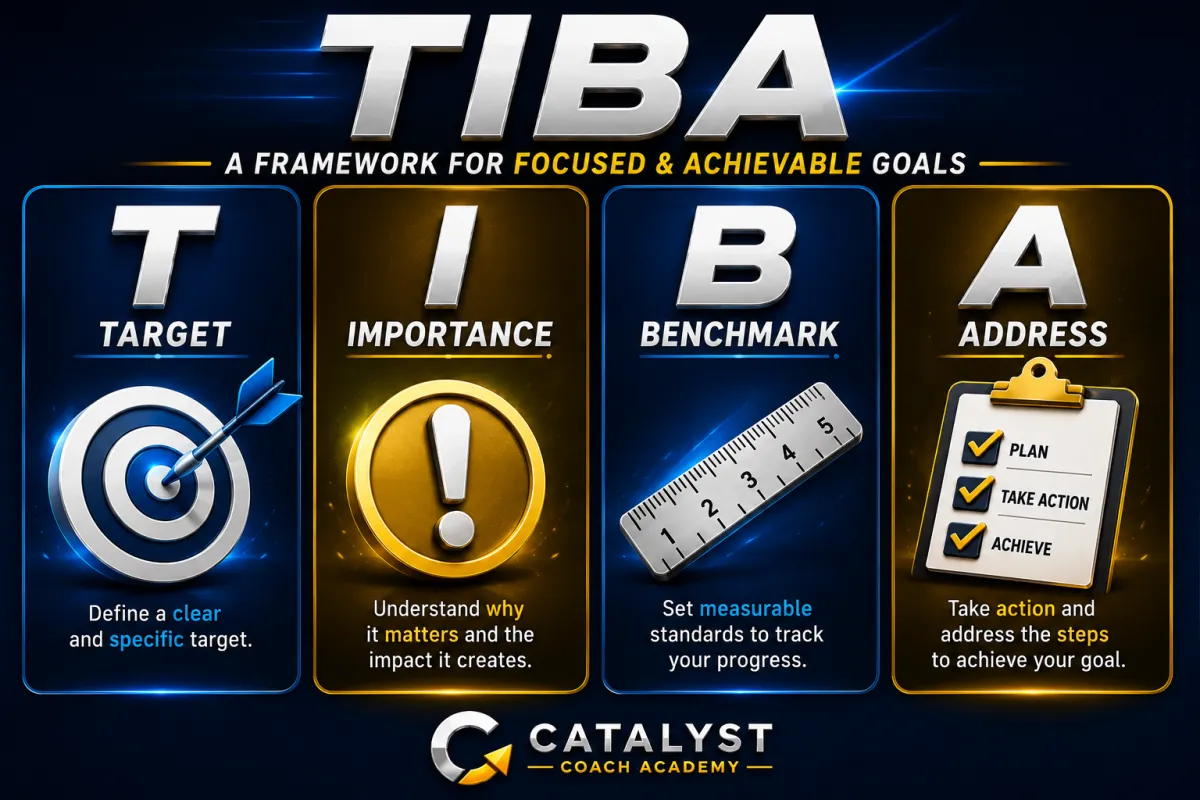
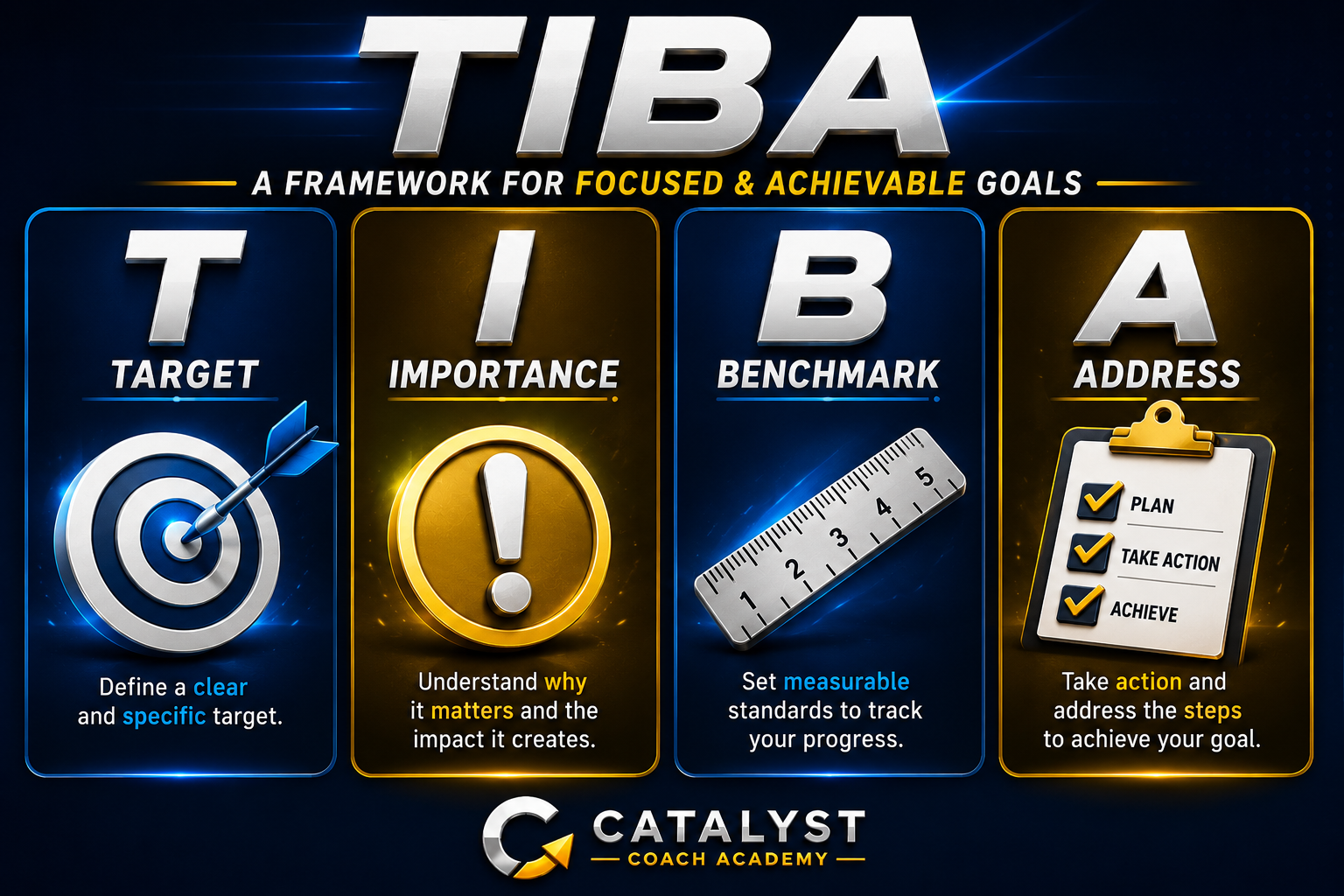
TIBA is not an official ICF model. It is a practical tool we developed inside our programs to help coaches create agreements that are deeply aligned with ICF Core Competency 3 while still feeling natural and conversational. TIBA stands for:
- T — Target: What specifically does the client want to focus on in this session?
- I — Importance: Why does this matter to the client right now? What makes this worth exploring?
- B — Benchmark: How will we both know that this conversation has been useful? What will success look or feel like by the end of the session?
- A — Address: What will the client do with the awareness they gain? How will they integrate or act on what emerges?
T — Target: Define the Focus of the Conversation
The Target is the heart of the coaching agreement. It answers the question: What are we really here to explore today? Without a clear target, even a skillful conversation can feel like driving without a destination. With a clear target, both coach and client know where they are heading, even if the route is flexible.
Diffuse Target vs. Focused Target
Diffuse Target: Sofia begins with, “I’m feeling stuck in my career.” The coach replies, “Tell me more about that.” They talk about her boss, her company, her skills, her doubts, and her long-term dreams. There is insight, but by the end Sofia says, “I’m still not sure what to do next.” The topic was big; the target was blurry.
Focused Target Using TIBA: The same opening, but this time the coach slows down and helps Sofia define a target:
- “When you say ‘stuck,’ what part of your situation feels most important to look at today?”
- “If we focus our time, what would you like to have more clarity about by the end of this session?”
Sofia reflects and says, “I want to decide whether it makes sense to explore internal opportunities before I look outside the company.” Now the session has a specific, client-chosen target. The conversation becomes more strategic and actionable because both coach and client know what they are working toward together.
“A strong target isn’t chosen by the coach — it’s chosen by the client. The coach’s job is to help them focus it.”
I — Importance: Connect With What Actually Matters
Once the target is clear, many new coaches rush ahead into exploration. TIBA invites you to pause and ask: Why does this matter? This is the Importance step — the bridge between a topic and the client’s deeper motivations, values, and context. It transforms a technical goal into a meaningful one.
Questions That Surface Importance
- “What makes this the right moment to explore this?”
- “Why is this important to you personally, beyond the practical outcome?”
- “How does this connect with the kind of leader / professional / person you want to be?”
- “What could become possible for you if we make progress on this today?”
From Time Management to Presence and Values
Imagine a client who says, “I want to manage my time better.” Many coaches would jump straight into tools and strategies. With TIBA, you explore Importance first. You might ask, “What makes time management especially important for you right now?” The client pauses and responds, “Because I’m missing dinner with my kids three nights a week, and that’s not the parent I want to be.”
Suddenly, the session is no longer about generic productivity. It’s about presence, identity, and values. As you continue to explore Importance, the client might say, “I want to feel that my calendar reflects what I say matters most to me.” Now you’re coaching the whole person, not just their schedule. Any tools or strategies you co-create will be anchored in something far more powerful than a to-do list.
B — Benchmark: Define What Success Looks Like
If Target and Importance tell us what we are focusing on and why it matters, the Benchmark clarifies how we will know the conversation has been useful. This is where we often see a clear difference between emerging ACC-level coaching and strong PCC-level coaching. Many coaches stop after Target and Importance. Adding a Benchmark takes the agreement to another level of clarity and shared responsibility.
Examples of Strong Benchmarks
- “By the end of this session, I’d like to have three concrete options for how to approach my manager about the project timeline.”
- “Success for me would be leaving with a clearer sense of what ‘enough’ looks like in this season, so I can make decisions about my workload.”
- “I’d like to walk away with one specific boundary I feel ready to set this week.”
A — Address: The Bridge Between Awareness and Action
The final element of TIBA, Address, asks: What will the client do with what emerges here? This doesn’t mean turning every session into a productivity sprint. Instead, Address honors the fact that insight wants a pathway. Even a subtle internal shift can be “addressed” in a concrete way.
Questions That Explore Address
- “Given what you’re seeing now, what feels important to do, say, or decide next?”
- “How do you want this new awareness to show up in your week ahead?”
- “What, if anything, would you like to commit to between now and our next session?”
- “What support or structure would help you honor this shift you’re naming?”
In TIBA, “action” is not limited to tasks. It might be a conversation the client chooses to have, a boundary they decide to set, a practice they begin, or even a new way of seeing themselves that they consciously nurture. What matters is that the client leaves with a sense of how they will carry forward what emerged in the session, rather than letting it fade as a nice insight with no impact.
Why TIBA Works
TIBA works because it is simple on purpose. Many new coaches try to hold the entire ICF Core Competency framework in their heads while they are coaching. They mentally juggle lists of behaviors, fear missing something, and end up sounding stiff or over-structured. Paradoxically, this anxiety pulls them away from their natural strengths as listeners and partners in thinking.
With TIBA, you only need to remember four words: Target, Importance, Benchmark, Address. These four elements echo the heart of ICF Core Competency 3 while giving you a mental map you can carry lightly. Once you internalize TIBA, you stop worrying about whether you are “doing the agreement right” and can give your full attention to the human being in front of you.
- Target keeps the conversation focused and intentional.
- Importance roots the work in what truly matters to the client.
- Benchmark creates shared visibility of progress and success.
- Address ensures that insight leads to integration and impact.
A Final Thought
Powerful coaching does not begin with a brilliant question. It begins with a clear, co-created agreement about what this time is for and why it matters. Before the first deep silence, before the first reframing, there is a moment when the client hears themselves say, “This is what I want to focus on today. This is why it matters to me. This is what ‘good’ would look like by the end.” That moment alone can shift their sense of agency and possibility.
When you use the TIBA coaching framework, you are not just meeting an ICF requirement. You are offering your clients a rare kind of clarity: a defined target in a world of distractions, a connection to what they truly value, a shared understanding of success, and a path for carrying their insights into the days and weeks ahead. In that space, even a single session can become a turning point rather than just another good conversation.
And perhaps, as you read this, you notice something stirring in your own journey. Maybe you recognize that you have been coaching informally for years, and you are ready to bring more intentional structure and professional rigor to what you already do so well. Maybe you sense that learning to craft strong, ICF-aligned agreements is not just about passing an assessment; it is about honoring the people who trust you with their stories by giving their goals the clarity they deserve.
An Open Invitation
If TIBA resonates with you, you might be ready for what comes next. At Catalyst Coach Academy, we train coaches who want both excellence and heart — coaches who care about ICF standards and about the human beings behind every competency. Inside our cohorts, you don’t just learn concepts; you practice them in real conversations, with real feedback, in a community that is committed to your growth.
If you are an experienced professional exploring ACC or PCC coaching certification, and you want to feel confident not only in your questions but in your agreements, we would be honored to walk with you. Our next cohort is forming now. You are invited to explore whether this is the right step for you.
Connect with us here to learn more and apply. Your next powerful coaching conversation might begin with a clearer agreement than ever before.
