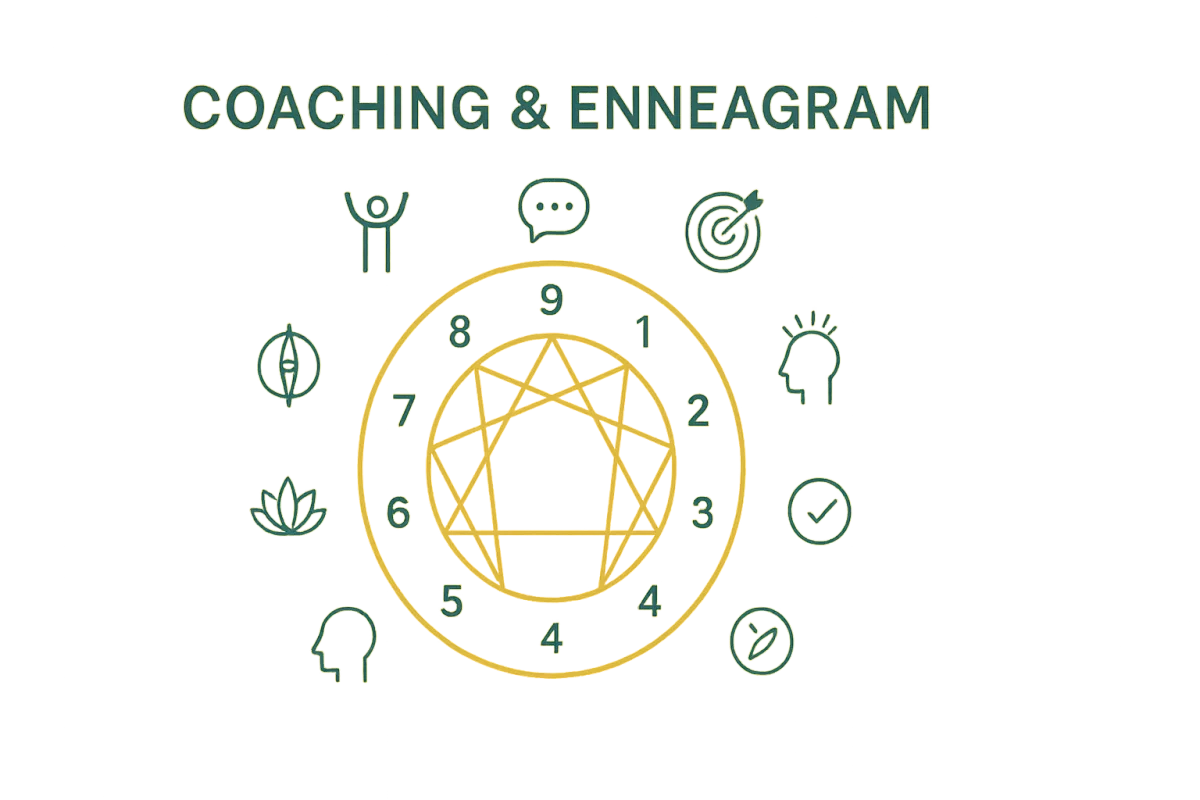
Your Enneagram Type, Your Coaching Strengths, and the Growth That Unlocks Your Next Level
Jump to Your Type
Type 1 — The Principled Coach Type 2 — The Generous Coach Type 3 — The Achieving Coach
Type 4 — The Depth Coach Type 5 — The Insightful Coach Type 6 — The Trustworthy Coach
Type 7 — The Expansive Coach Type 8 — The Powerful Coach Type 9 — The Presence Coach
Here is something I wish someone had told me before I started coaching.
The most important thing you will ever bring into a coaching session is not a question. It is not a framework. It is not even the number of hours you have logged or the credential behind your name.
Your history. Your wiring. The way you naturally listen, the things you instinctively notice, the places where you lean in — and the places where, without realizing it, you pull back. All of it comes into the room with you every single time. And all of it shapes what kind of coach you are, and what kind of coach you are still becoming.
This is one of the reasons I return to the Enneagram again and again in my work with coaches — not as a personality quiz, not as a box to climb into, but as a mirror. A specific, honest, sometimes uncomfortable mirror that shows you not just your gifts, but the shadow side of those gifts. The places where your greatest strengths, left unexamined, quietly limit the clients in front of you.
I have trained and mentored coaches at every stage of development. People exploring coaching for the first time through ICF coach training. Coaches working toward their ACC and PCC credentials. Coaches with thousands of hours who are pursuing MCC. And across all of that, one thing holds consistently true: the coaches who grow the fastest are the ones who know themselves the most honestly.
This post is for you if you are somewhere on that journey. Find your number below. Read slowly. And if something makes you a little uncomfortable — pay attention to that. That is usually where the growth lives.
Type 1 — The Principled Coach
“I just want to do this right.”
If you are a Type 1, you probably came to coaching because you genuinely care — about doing good work, about ethical practice, about making a real difference rather than just going through the motions. That is not a small thing. This profession needs people who take it seriously.
⭐ What You Bring to the Coaching Relationship
Clients feel safe with you in a specific and uncommon way. Not just emotionally safe — structurally safe. They sense that you have thought carefully about what you are doing, that you hold yourself to a standard that most people never articulate but can feel immediately. That quality of conscientiousness creates a container that clients trust, often before they can explain why.
You are also gifted at helping clients see the gap between what they say they value and how they are actually living. Your radar for misalignment is finely tuned — and when you learn to use it with genuine curiosity rather than quiet judgment, it becomes one of the most powerful tools in your coaching practice.
⚡ Where It Gets Complicated
You have an inner critic. What you may not have fully reckoned with yet is that your inner critic does not always stay pointed at yourself. In the coaching relationship, your strong internal sense of how things should be can subtly bias your listening — steering clients toward what you privately assess as the right answer.
That is not coaching. That is advice wearing the clothes of questions. And it is one of the most common and most invisible patterns in Type 1 coaches.
🌿 Your Growth Area
Notice the moment your inner standard activates and consciously release it before your next question. Ask yourself: Am I curious about where they are going, or am I curious about whether they are going the right way?
Those are different questions. And the answer shapes everything that follows.
✨ What Changes Everything
When Type 1 coaches learn to bring their integrity without their judgment — to be fully present to a client's process without consulting their own internal standard — something remarkable opens up. Clients do not just feel held. They feel genuinely free. And that freedom is often exactly what they needed to move.
Type 2 — The Generous Coach
If you are a Type 2, you probably did not need a personality framework to tell you that you care about people. You came to coaching because the idea of being genuinely present for someone's growth resonated with something deep and real in you.
⭐ What You Bring to the Coaching Relationship
You make people feel seen. Not just heard — truly seen. There is a quality of attention you bring that clients feel from the very first session. They feel like they genuinely matter to you, like you are rooting for them, like this is a real relationship and not a transaction.
That relational warmth is foundational. Trust is the container everything else in coaching happens inside of — and you build it naturally, quickly, and in a way that many coaches spend years trying to develop.
⚡ Where It Gets Complicated
The shadow side of caring deeply is that it makes it genuinely hard to let clients be uncomfortable. And coaching, done well, sometimes requires exactly that. When a client is circling something they are not quite ready to face, the most powerful thing a coach can do is stay with them there — not rescue them, not soften the edges.
Because approval matters to you, you may unconsciously calibrate your coaching toward what keeps the client feeling good about you, rather than what actually moves them.
🌿 Your Growth Area
Before your next challenging observation, notice whether you are softening it — adding a cushion, hedging the landing, checking internally whether the client will still like you after you say it.
Practice delivering one uncomfortable truth per session. The relationship almost never breaks. It almost always deepens.
✨ What Changes Everything
When Type 2 coaches learn to separate their care for the client from their need for the client's appreciation, their coaching reaches the depth that their warmth always promised. The most generous thing you can offer is not comfort. It is being believed in fiercely enough to be challenged.
Type 3 — The Achieving Coach
“Let’s get clear on what you want and go get it.”
If you are a Type 3, you probably bring an energy to coaching that clients find immediately activating. You speak the language of goals and results fluently — not because you learned it, but because you live it. There is something genuinely contagious about the way you engage with a client's potential.
⭐ What You Bring to the Coaching Relationship
You are exceptional in the momentum phase of coaching. When a client is ready to move, you help them move well — with clarity, focus, and strategic thinking that turns good intentions into actual action.
You are particularly gifted with high-achieving clients and executives who have been under-challenged. You meet them where they actually are — and that matching is something they have often been hungry for without knowing it.
⚡ Where It Gets Complicated
You are wired for results. And coaching is not always a results-producing process in the visible, measurable sense. Some of the most important sessions produce nothing tangible — no action items, no decisions, no forward movement anyone could observe. That is real and significant work.
Without awareness, Type 3 coaches can unconsciously collude with a client's preference for action over reflection — skipping past the real issue to get to the solution.
🌿 Your Growth Area
Build deliberate stillness into your sessions. When you feel the pull toward action — toward the next step, the strategy, the plan — pause and ask one more question that goes deeper rather than forward.
Trust that the session which produces nothing visible may have done the deepest work.
✨ What Changes Everything
When Type 3 coaches learn to stop needing coaching to look like achievement, something opens up. You discover a quality of presence that is more powerful than any goal-setting framework you have ever used — and your clients feel the difference immediately.
Type 4 — The Depth Coach
“I want to understand what is really going on for you.”
If you are a Type 4, you are probably already comfortable in the territory that makes many coaches nervous — the complicated emotions, the existential questions, the conversations that do not resolve, they just deepen. You can sit with complexity, and your clients feel that permission in their bones.
⭐ What You Bring to the Coaching Relationship
You go where others do not. In a coaching culture that defaults to quick reframes and five-step frameworks, your willingness to stay in the difficult and the unresolved is a genuine and rare gift.
You are also gifted at helping clients access what is most true for them beneath the surface — the identity questions, the longings, the deeply held values driving behavior in ways they have never quite named.
⚡ Where It Gets Complicated
Depth for its own sake is not always what the client needs. The Type 4's pull toward the emotional register can sometimes keep a client in the water when they are genuinely ready to get to shore.
Your own relationship with melancholy can color your listening. A client's wholeness is not less interesting than their wound — but it can feel that way to a Type 4 coach who has not yet examined this pattern.
🌿 Your Growth Area
At the midpoint of each session, deliberately scan for the client's strength, not just their struggle. What is working? What have they already navigated? What does their resilience tell you about what is possible?
Practice asking at least one question per session oriented toward capability rather than complexity. This is not toxic positivity. It is completeness.
✨ What Changes Everything
When Type 4 coaches learn to track the full range of a client's experience — the joy, the capability, the readiness alongside the depth — their coaching becomes both more complete and more spacious. You stop being the coach who is best for certain clients and start being the coach who can meet any client wherever they actually are.
Type 5 — The Insightful Coach
“Let me think carefully about what you really need.”
If you are a Type 5, your questions are not accidental. You have thought about them. You bring a level of precision and intellectual care to coaching that clients with complex problems find genuinely valuable — the sense of being understood at depth, not just reflected back in slightly different words.
⭐ What You Bring to the Coaching Relationship
You ask questions that land. Not because you are performing curiosity, but because you have actually thought carefully about what this person needs to consider.
You also give people room to actually think — and for clients who are constantly over-managed and over-directed in their professional lives, that room can be one of the most useful things a coach has ever offered them.
⚡ Where It Gets Complicated
Coaching is a relational process. Not just an intellectual one. The warmth, the genuine human connection, the felt sense of being accompanied — these are not decorative elements. They are part of what makes the work work.
Type 5 coaches can sometimes inhabit a slight remove — observing and analyzing the session with one part of themselves while another part participates. Clients feel understood, but they do not always feel truly accompanied.
🌿 Your Growth Area
At the start of each session, before the first question, take one moment to consciously arrive — not just intellectually, but relationally. Notice the person in front of you. Not the problem they are bringing. The person.
Let the client feel your investment in them as a human being, not just your engagement with their situation as an interesting problem.
✨ What Changes Everything
When Type 5 coaches learn to bring not just their thinking but their full presence — their warmth, their genuine care — clients do not just feel understood. They feel accompanied. And being accompanied turns out to be more transformational than being understood.
Type 6 — The Trustworthy Coach
“I want to make sure you are genuinely supported and that we do this right.”
If you are a Type 6, your clients are probably more loyal to you than you sometimes realize. Because what you offer — consistency, genuine care about their wellbeing, a quality of reliability that does not waver — is rarer in coaching than it sounds.
⭐ What You Bring to the Coaching Relationship
You take the responsibility of coaching seriously in a way that clients feel. You think carefully about ethics, are honest about the limits of your role, and do not overextend into territory that is not yours to hold. That integrity creates structural safety — clients know you have thought this through.
You are also particularly gifted at helping clients navigate genuine uncertainty. You understand fear from the inside and can hold a client's anxiety without dismissing it.
⚡ Where It Gets Complicated
Your finely tuned risk antenna is not always calibrated to your client. Sometimes it is calibrated to you. Not every client who is considering a leap needs to slow down.
Your instinct to scan for what could go wrong can sometimes introduce caution into a coaching relationship that actually needs encouragement toward the edge.
🌿 Your Growth Area
When you notice yourself introducing caution, pause and ask: Is this about them or about me? That is not a comfortable question. But it is the most useful one.
Supervision and peer coaching are particularly valuable for Type 6 coaches here — it is hard to see this pattern alone.
✨ What Changes Everything
When Type 6 coaches learn to trust the client's capacity — and to trust themselves — without needing to secure the outcome in advance, their coaching opens up dramatically. The uncertainty that once felt like a problem to be managed becomes part of the process they know how to hold.
Type 7 — The Expansive Coach
“There is so much possible here — let’s open this up.”
If you are a Type 7, clients probably leave their sessions with you feeling more alive than when they arrived. You have a genuine and rare gift for possibility — for seeing options that the client had stopped seeing, for reframing in ways that shift what feels available.
⭐ What You Bring to the Coaching Relationship
You are extraordinary with clients who are stuck in limiting narratives. You are the coach who blows that open. Not with false optimism but with genuine creative intelligence and a natural orientation toward freedom that clients can borrow until they locate their own.
Your enthusiasm is not a performance. Clients feel that you genuinely believe in their potential and are present to what is possible for this person.
⚡ Where It Gets Complicated
Pain is part of life. It is part of the coaching relationship. And the Type 7's instinct can sometimes move away from pain rather than through it.
When a client hits a genuinely difficult emotional place — grief, fear, shame — the most powerful response is often simply to stay there with them. Not to find the silver lining. Not to reframe toward possibility before the client is ready. Just to be present with what is hard.
🌿 Your Growth Area
Feel the pull toward reframe, toward possibility, toward the lighter register — and then consciously choose to stay one more moment in what the client is actually experiencing.
Ask: What is this like for you right now? Practice the art of accompanying someone in difficulty without fixing it. That is the coaching skill that will most expand your range.
✨ What Changes Everything
When Type 7 coaches learn that staying with difficulty is not the same as being stuck in it — that presence with pain is its own form of freedom — their range expands dramatically. You become capable of the full spectrum of coaching, not just the upper half.
Type 8 — The Powerful Coach
“I believe in you. Now let’s stop letting you play small.”
If you are a Type 8, you probably have a low and genuine tolerance for watching people underestimate themselves. You see what people are capable of — sometimes more clearly than they do — and there is something in you that refuses to collude with their smallness.
⭐ What You Bring to the Coaching Relationship
You challenge people in ways that other coaches are afraid to. Not harshly — powerfully. The leaders who have spent their careers surrounded by people who agree with them often describe working with a Type 8 coach as one of the most significant professional experiences of their lives.
You advocate for your clients with a fierceness that they feel — in the way of someone who genuinely believes they can do the hard thing and will not let them off the hook.
⚡ Where It Gets Complicated
The most important growth edge for Type 8 coaches is also one of the most fundamental principles of coaching: the client is in the driver's seat. Not the coach.
Because Type 8s have strong instincts about what a person needs, there is a real risk of subtly steering the coaching toward what you think the client should do. The “powerful question” can actually be a very direct suggestion wearing a question mark.
🌿 Your Growth Area
At the end of each session, ask yourself honestly: Whose agenda was I coaching from today? Notice the moments where your instinct about what the client needed overrode your curiosity about what the client was actually pursuing.
Practice asking “what do you want?” more often than telling people what you see them capable of. Both are powerful. The first is coaching.
✨ What Changes Everything
When Type 8 coaches learn to channel their power fully in service of the client's agenda — to be fierce in the direction the client is actually trying to go — your coaching becomes both more precise and more transformational. The directness that was always a gift becomes an extraordinary one.
Type 9 — The Presence Coach
“I am here. Take all the time you need.”
If you are a Type 9, you may not always think of yourself as having a distinctive coaching identity — because your gift is not a style or an approach so much as a quality of being. You create space. Real space. The kind that is increasingly rare in a world that moves fast and fills every silence.
⭐ What You Bring to the Coaching Relationship
Clients exhale when they are with you. Something in them slows down and opens up, often before anything has even been said. You are not in a hurry, not managing them toward an outcome, and not performing presence — you are actually present in a way that is genuinely uncommon.
You are also gifted at holding multiple perspectives simultaneously without needing to resolve them into one — helping clients think through genuine complexity without inadvertently pushing them toward the conclusion you would choose.
⚡ Where It Gets Complicated
Your gift for harmony can cost your clients something important. There are moments in the coaching relationship that call for disruption — for naming what you are genuinely observing, even if it creates friction.
Type 9 coaches can struggle with those moments. Not because they lack the perception — you often see exactly what is happening. But because the impulse toward harmony is so deeply wired that naming what is true can feel like a violation of the safety you have worked so hard to create. It is not. It is the completion of it.
🌿 Your Growth Area
Once per session, share what you are genuinely noticing — without softening it first, without the cushion of “I might be wrong about this, but...”
Just say it. I notice you have shifted topics three times when we get close to this. What is that about? Those observations are not disruptions. They are the most honest form of care you can offer.
✨ What Changes Everything
When Type 9 coaches learn that their voice — their genuine, direct, sometimes uncomfortable observations — is not a disruption of the coaching relationship but the deepest expression of it, something opens up. Clients do not just feel held. They feel met. Truly met. And being met, truly met, is often what changes everything.
The Thread Running Through All Nine
If you read your type and felt something — recognition, a small discomfort, the quiet sense of that is exactly it — you already understand the most important thing this framework has to offer.
Self-knowledge is not a detour from coaching mastery. It is the path to it.
The coaches who develop most powerfully are not always the most naturally gifted ones. They are the ones who kept getting more honest with themselves. Who stayed curious about their own patterns long after they felt competent.
Your Enneagram type does not determine your ceiling as a coach. It describes your starting point — and the specific terrain of your development. What you do with that awareness is entirely up to you.
Related Reading
→ What Is the ICF ACC Credential and Is It Worth It?
→ Why the MCC Credential Is the Gold Standard in Professional Coaching
→ Is Coaching Right for Me? An Honest Guide for People Considering the Profession
Jamie Slingerland, MCC is a leadership coach, ICF Mentor Coach and Assessor, and Co-Founder of Catalyst Coach Academy — an ICF-accredited coaching education program led exclusively by Master Certified Coaches. She has trained and mentored coaches across the United States, the Middle East, and beyond.
FAQ: Enneagram and Coaching
How does the Enneagram apply to coaching?
The Enneagram offers a nuanced map of your motivations, strengths, and blind spots. In coaching, it becomes a lens for self-observation: how you listen, where you over-function, and what you avoid. Used thoughtfully, it supports ethical, client-centered practice rather than labeling either you or your clients.
Does my Enneagram type limit my coaching effectiveness?
No. Your type describes patterns, not potential. Every type has powerful coaching gifts and predictable overuses of those gifts. When you stay curious about your patterns and seek feedback, your type becomes a starting point for growth, not a ceiling on how effective or masterful you can become.
Does ICF coach training address Enneagram self-awareness?
The ICF does not require Enneagram work specifically, but accredited programs emphasize self-awareness, presence, and ethics. Many schools, including ours, integrate tools like the Enneagram alongside the ICF Core Competencies to help coaches notice how their type shows up in real sessions.
What growth edge do most coaches share regardless of type?
Across types, a common edge is loosening attachment to your preferred way of helping. Whether you default to fixing, encouraging, analyzing, or deepening, the shared growth task is the same: notice your pattern, release it in the moment, and return to genuine curiosity about the client’s agenda.