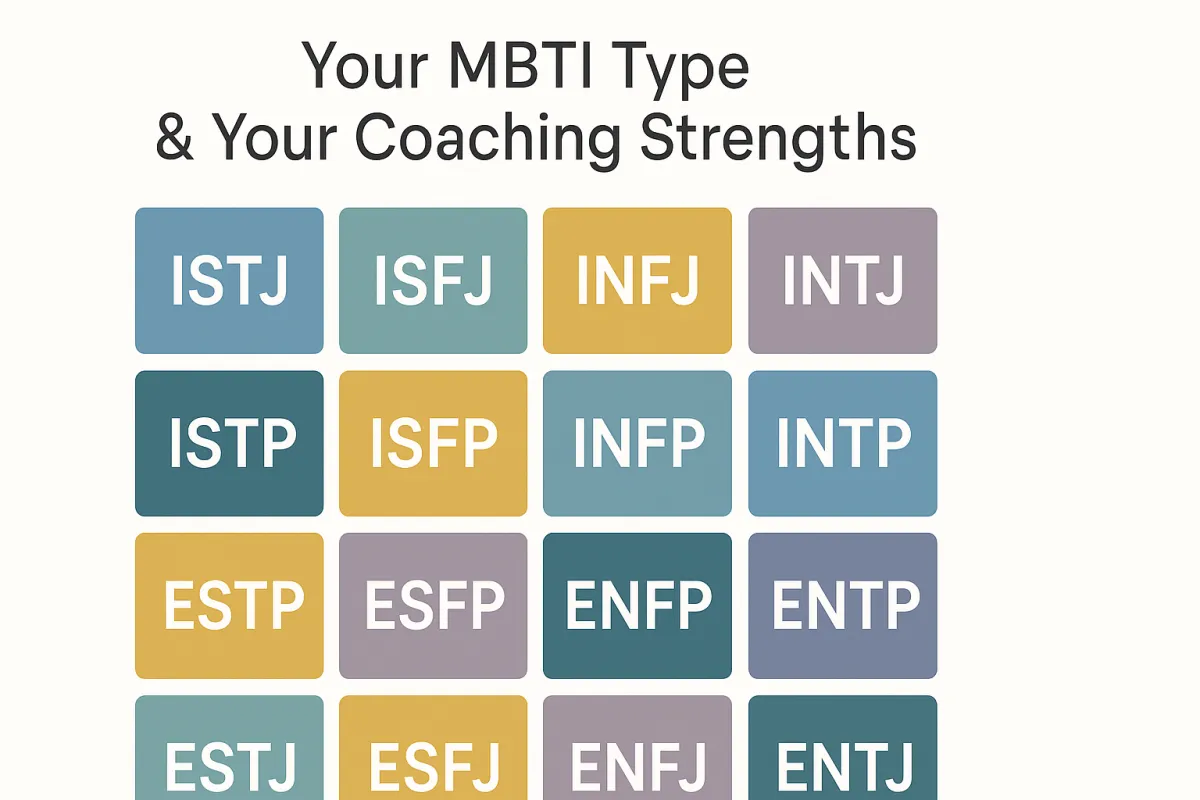
MBTI for Coaches: The Complete Strengths Guide for All 16 Personality Types
Coaching, MBTI, ICF Credentialing
Explore how each of the 16 MBTI types shapes your natural coaching strengths — and how deeper self-awareness can elevate your coaching presence, your impact with clients, and your journey through ICF credentials and professional development.
Most people encounter Myers-Briggs for the first time and walk away with a four-letter type they put in their Instagram bio or mention in a job interview.
Coaches can do something much more interesting with it.
The MBTI is not just a personality snapshot. When you understand it at depth — when you actually examine what your type means for how you listen, how you ask questions, how you process what a client is telling you, and where you naturally direct your attention — it becomes a remarkably precise map of your coaching strengths.
Not your weaknesses. Your strengths.
This post is built on a simple premise: every MBTI type brings something genuinely valuable to the coaching relationship. Not some types more than others. All sixteen. The client who gets a coach whose type is well-developed and well-understood is getting something specific and real — a quality of attention that comes from that coach's wiring and no one else's.
What follows is a guide to what each type actually gives you as a coach. Not what makes you difficult. Not what you need to overcome. What you bring — the specific gifts that your type, at its best, offers to the people who trust you with their growth.
Know your type? Find yourself below. Do not know it yet? The four dichotomies are Extraversion/Introversion, Sensing/Intuition, Thinking/Feeling, and Judging/Perceiving. A quick search will point you to a free assessment. Then come back and read slowly.
A Note Before You Begin
The MBTI describes preferences — the ways of engaging with the world that come most naturally to you. It does not describe your ceiling or your limits. The most masterful coaches develop the capacity to access the full range of coaching presence, not just the range that comes easily to their type. This is where a solid ICF coach training or structured coach training program can give you language and practice far beyond your defaults.
But you cannot transcend what you have not first understood. And you cannot fully use what you have not yet named.
That is what this post is for.
ISTJ — The Reliable Coach
"I will show up for you. Every time. Without exception."
What Your Type Gives You
Clients with an ISTJ coach know something that clients of many other types do not always know: that their coach is fully prepared, fully present, and fully committed to the work. You do not wing sessions. You do not show up distracted. You have thought carefully about where this client is and what this session needs — and that preparation creates a quality of safety that clients feel from the very first session.
Your gift is consistency. In a world that is often chaotic and unpredictable, you are the steady point. Clients can rely on you to remember what they said three sessions ago, to track the thread of their development over time, to notice when something they said today contradicts something they said last month. That longitudinal attention — the ability to hold the whole arc of a coaching relationship, not just the current session — is something that comes naturally to you and that many clients have never experienced before.
You are also gifted at helping clients develop structure and accountability. Not by imposing your system on them, but by genuinely believing in the value of follow-through and conveying that belief in a way that clients internalize.
Your Coaching Superpower
You are the coach clients trust completely. And that trust — the specific, structural, earned trust that comes from consistent reliability — is the container in which the deepest coaching work happens. Do not underestimate it. Many clients have never had a professional relationship this dependable. That alone can be transformational.
What to Stay Curious About
The invitation for ISTJ coaches is to stay genuinely open when a client's process looks different from what you would expect or what has worked before. Your gift for structure can occasionally become a preference for process over presence. The most powerful sessions sometimes look nothing like what you planned.
ISFJ — The Attuned Coach
"I see you. All of you — not just the parts you show everyone else."
What Your Type Gives You
ISFJ coaches bring a quality of attentiveness that is genuinely rare. You notice things. The slight hesitation before a client answers. The way their energy shifts when a particular topic comes up. The detail they mentioned once three sessions ago that they have not brought up since but that you have been quietly holding. That quality of sustained, caring attention is one of the most profound things a coach can offer — and for you, it is not effortful. It is simply how you engage with people you care about.
You are also gifted at creating emotional safety quickly. Clients feel, early in a coaching relationship with you, that they are genuinely cared for — not managed, not processed, but actually cared for. That safety is the foundation on which everything else is built. Without it, clients cannot be honest. With it, they can go anywhere.
Your memory for what clients have shared — the specifics of their situation, the people in their lives, the context that shapes their decisions — means that clients never have to re-explain themselves to you. They can build on what has already been established. That continuity is a gift that clients often do not know to name but feel deeply.
Your Coaching Superpower
You make clients feel genuinely known. Not assessed, not categorized — known. In a coaching culture that can sometimes feel clinical or technique-driven, your warmth and attentiveness remind clients that this is a human relationship, and that they are a person rather than a problem to be solved.
What to Stay Curious About
The invitation for ISFJ coaches is to trust that your own observations and perspectives belong in the coaching relationship. Your attunement to the client can sometimes make you reluctant to introduce friction or disruption. But your genuine, caring directness — offered from the deep knowledge you have of this person — is often exactly what moves them.
INFJ — The Visionary Coach
"I can see something in you that you cannot quite see yet."
What Your Type Gives You
INFJ coaches have an almost uncanny ability to see beneath the surface of what a client presents. Where others hear the stated question, you sense the deeper one. Where others see the decision the client is wrestling with, you perceive the identity question underneath it. That depth of insight — when it is offered carefully and at the right moment — can produce the kind of breakthrough that clients describe for years afterward.
You are also gifted at holding a vision for a client that the client cannot yet hold for themselves. Not a vision you impose — a vision you perceive in them, based on what they have shared and who they are becoming. Reflecting that vision back, at the moment the client most needs to see it, is one of the most powerful things a coach can do. It is something you do naturally.
Your ability to synthesize — to take the disparate threads of what a client has shared across many sessions and weave them into a coherent pattern — gives clients a sense of being deeply understood in a way that transcends any single session.
Your Coaching Superpower
You see people's potential with unusual clarity — often before they can see it themselves. And the experience of being seen that clearly, by someone who genuinely believes in what they see, can change the trajectory of a client's life.
What to Stay Curious About
The invitation for INFJ coaches is to hold your insights loosely — to offer them as possibilities rather than perceptions, and to stay genuinely curious about whether what you are seeing is the client's truth or your own pattern-matching. Your intuition is a remarkable gift. It is also, occasionally, a projection. The discipline of checking is what keeps it trustworthy.
INTJ — The Strategic Coach
"Let's get to the real question underneath the one you are asking."
What Your Type Gives You
INTJ coaches bring a quality of strategic clarity that clients with complex situations find extraordinarily valuable. You cut through quickly — not impatiently, but with precision. You identify the real issue, the underlying pattern, the structural problem that is generating all the surface-level symptoms — and you do it faster and more accurately than almost any other type.
You are also gifted at long-range thinking. While many coaching conversations stay close to the immediate — the next decision, the current challenge — you naturally think in systems and timelines. You help clients see not just what to do next but what kind of future they are building with their choices. That strategic horizon is something clients with big ambitions and complex contexts find genuinely rare.
Your intellectual rigor means clients can bring you their most complicated situations and trust that you will engage with the full complexity rather than simplifying prematurely. You do not need things to be neat. You can hold complexity while still moving it toward clarity.
Your Coaching Superpower
You help clients think at a level they cannot reach alone. The insight that restructures how a client understands their entire situation — the one that makes everything suddenly legible — is the kind of coaching moment that INTJ coaches produce with unusual frequency.
What to Stay Curious About
The invitation for INTJ coaches is to stay fully present to the client's emotional experience alongside their strategic situation. Your clarity is a gift. Occasionally it can move faster than the client is ready to follow — arriving at the insight before the client has had the experience of discovering it themselves. The coaching magic often lives in the journey to the insight, not just the insight itself.
ISTP — The Grounded Coach
"Let's cut through the noise and focus on what is actually true."
What Your Type Gives You
ISTP coaches bring a quality of groundedness that clients under pressure find deeply stabilizing. You are not rattled by complexity. You are not impressed by drama. You have an ability to stay calm and clear in the middle of the client's chaos — and that calm is not performed, it is genuine, and clients feel the difference immediately.
You are gifted at helping clients separate what is actually happening from the story they are telling about what is happening. That distinction — between the facts and the interpretation — is one of the most useful things coaching can offer. And you make it with a directness and matter-of-factness that cuts through quickly and cleanly.
Your practical intelligence means clients leave sessions with you feeling clearer about what is real and what is possible — not pumped up on enthusiasm, but genuinely oriented. That quality of honest clarity is rarer and more valuable than it sounds.
Your Coaching Superpower
You are the coach clients go to when they need to think straight. When everything feels overwhelming and they cannot see clearly, your grounded, unflappable presence helps them find the signal in the noise. That is a specific and significant gift.
What to Stay Curious About
The invitation for ISTP coaches is to stay curious about the emotional dimension of a client's experience alongside the practical one. Clients sometimes need to feel heard in their difficulty before they can receive your clarity. The facts matter — and so does the experience of having the facts feel like too much.
ISFP — The Compassionate Coach
"There is no rush here. This is your process and I am with you in it."
What Your Type Gives You
ISFP coaches bring a quality of acceptance that clients who have been judged, managed, or assessed in most of their professional relationships find genuinely healing. You do not have an agenda for who your client should become. You are genuinely, unhurriedly present to who they are right now — and that unconditional quality of regard creates conditions for honesty that most clients have rarely experienced.
You are also deeply attuned to the aesthetic and experiential dimensions of a client's life — the things that genuinely matter to them, the values that are quietly driving their choices, the version of their life that would feel alive rather than merely successful. You help clients reconnect with what they actually want rather than what they think they should want. That reconnection is often the most important thing a coaching engagement produces.
Your gentleness is not weakness. It is a specific form of strength — the strength of someone who can be fully present with another person without needing to change them.
Your Coaching Superpower
You create the conditions in which clients can be completely honest with themselves, possibly for the first time. The breakthroughs that happen in your coaching relationships often come not from a powerful question but from a quality of safety so complete that the client finally says the thing they have been unable to say anywhere else.
What to Stay Curious About
The invitation for ISFP coaches is to trust your own perceptions enough to name them directly. Your acceptance of the client is one of your greatest gifts — and it occasionally makes it harder to offer the direct challenge that would move them most. Your observations, offered gently and from genuine care, are welcome. Trust that.
INFP — The Meaning Coach
"What would it mean to do something that actually matters to you?"
What Your Type Gives You
INFP coaches bring a depth of values-orientation to coaching that clients who are navigating questions of meaning and purpose find profoundly useful. You care, genuinely and deeply, about whether your clients are living in alignment with what matters most to them. Not what looks successful from the outside — what feels true on the inside.
That orientation is increasingly rare and increasingly needed. Many clients arrive at coaching having built a life that looks right from every external measure and feels hollow from the inside. The INFP coach is the one who can sit with that experience without rushing toward a solution — and who can ask the questions that help a client find their way back to themselves.
You are also gifted at helping clients articulate what they value in ways they have never quite managed before. The client who has always known something mattered to them but never had the language for it often finds that language in a session with an INFP coach.
Your Coaching Superpower
You help clients come home to themselves. The coaching work that reconnects a person with their own deepest values — that helps them build a life that is genuinely theirs — is the work that INFP coaches do with extraordinary natural skill.
What to Stay Curious About
The invitation for INFP coaches is to stay equally present to clients whose values and choices look different from your own. Your depth of values-orientation is a gift — and occasionally it can create a subtle preference for the client who is doing the existential meaning work over the client who genuinely just needs to make a good decision. Both are valid. Both deserve your full presence.
INTP — The Clarity Coach
"Let's think about this more carefully than you have been able to think about it alone."
What Your Type Gives You
INTP coaches bring exceptional analytical precision to the coaching relationship. You have a gift for identifying the logical inconsistency in a client's thinking — the assumption they have not examined, the conclusion that does not follow from the premises, the belief that is generating all the friction without anyone having noticed it yet.
That precision, offered in service of the client's own thinking rather than as correction, is one of the most practically useful things coaching can provide. Clients leave sessions with you understanding their own situation more clearly than they have before — not because you told them what to think, but because your questions helped them think more rigorously than they could alone.
You are also genuinely curious in a way that clients feel as respect. You find their situation interesting. You want to understand it fully. That intellectual engagement is not a technique — it is real, and clients experience the difference between a coach who is going through the motions of curiosity and a coach who is genuinely fascinated by what they are discovering.
Your Coaching Superpower
You help clients think their way to clarity. The moment when a client finally understands the pattern that has been generating a problem they have wrestled with for years — that moment happens with unusual frequency in sessions with INTP coaches. That is a profound gift.
What to Stay Curious About
The invitation for INTP coaches is to stay fully present to the emotional dimension of the client's experience alongside the intellectual one. The insight that is intellectually correct but emotionally premature does not always land. Clients need to feel accompanied, not just understood. Your warmth and genuine care — which are real, even if less visible than your intellectual engagement — belong in the coaching relationship too.
ESTP — The Activating Coach
"You already know what to do. Let's stop overthinking it and move."
What Your Type Gives You
ESTP coaches bring an energy to the coaching relationship that clients who are stuck in analysis paralysis find genuinely liberating. You have a bias toward action — not reckless action, but the practical, grounded recognition that at some point thinking has to become doing. And you convey that recognition in a way that activates clients rather than pressuring them.
You are gifted at reading a room — or a client — in real time. You notice when the energy shifts, when something lands differently than expected, when the client is ready to move even if they have not said so yet. That real-time responsiveness makes your coaching feel alive and dynamic rather than formulaic.
You are also pragmatic in a way that clients find refreshing. You meet clients in the practical reality of their situation — not in a theoretical ideal of what coaching should look like — and you help them find the most direct path from where they are to where they want to be.
Your Coaching Superpower
You create momentum. Clients who have been stuck — who have been thinking about the same thing for months without moving — often find that a handful of sessions with an ESTP coach produces more forward movement than a year of reflection. That is a real and significant gift.
What to Stay Curious About
The invitation for ESTP coaches is to stay present to the client who needs to slow down before they can move well. Not every client needs activation. Some clients need to feel the weight of what they are carrying before they are ready to put it down. Your gift for forward movement is powerful — and occasionally the most powerful thing you can do is resist it.
ESFP — The Energizing Coach
"I genuinely believe something good is possible for you here."
What Your Type Gives You
ESFP coaches bring warmth, genuine enthusiasm, and a quality of positive regard that clients who have been ground down by difficulty find deeply restorative. You believe in people. Not as a technique or a coaching stance — as a real orientation toward the humans in front of you. And that belief is contagious in the best possible way.
You are also extraordinarily present — not just attentive, but fully alive in the coaching relationship in a way that makes clients feel like this conversation matters. You are not thinking about your next question while the client is still talking. You are actually there, with them, in the moment. That quality of full-bodied presence is one of the most important things a coach can offer.
Your ability to find the genuine strength and possibility in a client's situation — without minimizing the difficulty — gives clients access to hope that is grounded rather than naive. That is a different thing from positivity. It is real.
Your Coaching Superpower
You make clients believe in themselves again. The client who came in feeling stuck, depleted, or like the situation was fixed — they leave a session with you with something they did not arrive with. Not a plan necessarily. A different relationship to what is possible. That is often the most important thing.
What to Stay Curious About
The invitation for ESFP coaches is to stay present when a client needs to stay in difficulty for a moment before moving toward the light. Your genuine orientation toward possibility is a gift — and occasionally the client most needs someone to simply be with them in the hard place before they are ready to see what else is there.
ENFP — The Possibility Coach
"What if everything you think is fixed is actually more open than you realize?"
What Your Type Gives You
ENFP coaches are among the most naturally gifted at expanding what clients believe is possible for themselves. You see potential with unusual clarity and unusual enthusiasm — and you communicate that vision in a way that is genuinely infectious. Clients who have been living in a narrowed sense of what their life can be often have that narrowing challenged and opened by a single conversation with an ENFP coach.
You are also gifted at making connections — between ideas, between patterns in the client's story, between what the client is saying now and something they said three sessions ago that is suddenly relevant. That connective intelligence creates moments of insight that feel almost magical to clients, even though they emerge from very careful listening.
Your genuine curiosity about people — about what drives them, what they dream about, what they have never quite let themselves want — creates conditions for honesty that clients find both rare and valuable.
Your Coaching Superpower
You give clients permission to want more than they have been allowing themselves to want. The coaching work that reconnects a person with their fullest sense of what is possible — that work is something ENFP coaches do with a naturalness and joy that is one of the most distinctive gifts in the profession.
What to Stay Curious About
The invitation for ENFP coaches is to stay fully present to the client who is not ready to expand yet — who needs to feel the weight of where they are before they can genuinely believe in something different. Your gift for possibility is real. It lands most powerfully when the client has first felt fully met in their current reality.
ENTP — The Reframing Coach
"What if the way you are looking at this is the actual problem?"
What Your Type Gives You
ENTP coaches bring a quality of intellectual challenge that clients who have been unchallenged in their thinking — or who are stuck inside a frame they cannot see — find genuinely transformational. You reframe naturally and brilliantly. Where a client sees a fixed situation, you see ten ways of looking at it that the client has not considered. Where a client sees an obstacle, you see a question that has not been asked yet.
That reframing ability is not just clever — it is, at its best, the thing that frees clients from the thinking that has been keeping them stuck. A well-placed reframe from an ENTP coach can shift a client's entire orientation in a single moment.
You are also energized by the coaching conversation itself — by the thinking, the exploring, the discovery — and that genuine engagement is something clients feel and respond to. You are not going through the motions. You are actually interested. That aliveness matters.
Your Coaching Superpower
You help clients escape the prison of their own assumptions. The frame that has been generating all the friction, the belief that has been quietly running everything — you see it, you name it, and you offer the client a way to stand outside it. That is a genuinely rare and powerful gift.
What to Stay Curious About
The invitation for ENTP coaches is to offer reframes as invitations rather than conclusions — and to stay curious about whether the reframe landed for the client or just felt satisfying to offer. The most powerful reframe is the one the client arrives at themselves, with your question as the catalyst. Trust the client's process as much as your own intelligence.
ESTJ — The Accountable Coach
"You said you wanted this. Let's make sure we are building the kind of structure that will actually get you there."
What Your Type Gives You
ESTJ coaches bring a quality of practical rigor to the coaching relationship that clients who struggle with follow-through find genuinely valuable. You take commitments seriously. When a client says they are going to do something, you remember — and you return to it with a directness that holds the client to their own stated intentions in a way that many clients have never experienced.
That accountability is not pressure. It is respect. You are treating the client's stated goals as real and worth pursuing — not as aspirations to be gently held without consequence. Many clients, for the first time in a development relationship, feel the particular kind of safety that comes from being genuinely held to account.
You are also gifted at helping clients develop the practical structure that turns intention into execution. The plan, the timeline, the specific next action — these are things you help clients build with unusual skill, and the clients who struggle to get from idea to reality often find that the missing piece was exactly this kind of concrete, structured thinking.
Your Coaching Superpower
You help clients close the gap between aspiration and action. The coaching that produces real, durable, life-changing results in the external world — that is what ESTJ coaches do at their best. And the clients who have been dreaming without doing find in you exactly what they needed.
What to Stay Curious About
The invitation for ESTJ coaches is to stay open to the session that does not produce a clear action plan — the session that goes deeper rather than forward, that surfaces something important without resolving it. Transformation does not always look like progress. Sometimes the most important work a session can do is slow everything down.
ESFJ — The Nurturing Coach
"How are you — really? Not the version you tell everyone else."
What Your Type Gives You
ESFJ coaches create some of the warmest, most relationally rich coaching relationships in the profession. You are genuinely invested in the people you coach — in their whole lives, not just the presenting challenge. Clients feel that investment, and it creates a quality of trust and openness that is the foundation of everything meaningful in a coaching engagement.
You are also gifted at helping clients navigate the relational dimensions of their challenges — the conversations they are avoiding, the relationships that are affecting their performance, the interpersonal dynamics that are quietly driving more of the situation than anyone has named. You understand people and how they operate together, and that understanding gives you particular skill in the territory where most leadership and life challenges actually live.
Your ability to hold a client's whole context — the work, the relationships, the family, the history — means clients never feel like they are being reduced to a single presenting issue. They feel like whole people. That matters enormously.
Your Coaching Superpower
You make clients feel genuinely cared for as whole human beings — not just as problems to be solved or goals to be achieved. In a profession that can sometimes drift toward the clinical or the transactional, your warmth reminds clients of what this relationship is actually for.
What to Stay Curious About
The invitation for ESFJ coaches is to stay present when a client needs direct challenge more than warm support. Your care for the client is real and valuable — and occasionally the most caring thing you can do is say something uncomfortable. Trust that your relationship is strong enough to hold it. It almost always is.
ENFJ — The Developmental Coach
"I can see who you are becoming — and I think it is worth working toward."
What Your Type Gives You
ENFJ coaches bring an extraordinary combination of warmth and vision to the coaching relationship. You genuinely care about your clients' growth — not just their immediate goals but their long-term development, their becoming. And you hold that vision for them with a steadiness and belief that clients often describe as one of the most sustaining experiences of their professional lives.
You are gifted at drawing out the best in people — at creating conditions in which clients feel both fully accepted and genuinely challenged to grow. That combination — unconditional positive regard held alongside high expectation — is the relational environment in which the most significant human development happens. You create it naturally.
Your ability to inspire is not manipulation or performance. It emerges from genuine belief in the people you work with — and clients feel the difference between being managed and being believed in.
Your Coaching Superpower
You hold the vision for your clients when they cannot hold it for themselves. In the moments when clients lose faith in their own possibility — when they are depleted, discouraged, or convinced that the gap between where they are and where they want to be is too wide — you are the steadying presence that keeps the vision alive until they can reclaim it.
What to Stay Curious About
The invitation for ENFJ coaches is to hold your vision for the client loosely enough that it does not become your agenda for them. Your belief in their potential is one of your greatest gifts — and occasionally it can create a subtle pull toward the version of their growth that looks most like flourishing to you. The client's path is theirs. Your role is to accompany it, not to determine it.
ENTJ — The Transformational Coach
"You are capable of significantly more than you are currently allowing yourself to attempt."
What Your Type Gives You
ENTJ coaches bring a rare combination of strategic vision and direct challenge that clients who are operating below their potential find genuinely activating. You see the gap between where a client is and where they could be — and you name it with a directness and confidence that many clients have never experienced from anyone in a development role.
You are also gifted at helping clients think at a systems level — to see not just the immediate decision but the structure of their situation, the patterns that are generating their outcomes, the strategic moves that would shift everything downstream. That level of thinking is something that many high-achieving clients hunger for and rarely find.
Your confidence in your clients' capability — your genuine unwillingness to collude with their self-imposed limitations — creates a particular kind of developmental pressure that the clients who need it find invaluable.
Your Coaching Superpower
You hold clients to the standard of their own highest capability and refuse to let them settle for less. The coaching relationship that produces the biggest leaps — in ambition, in clarity, in the willingness to attempt something genuinely difficult — is often the one shaped by an ENTJ coach at their best.
What to Stay Curious About
The invitation for ENTJ coaches is to stay as curious about the client's inner experience as you are about their strategic situation. The most significant shifts in leadership and life often happen not at the level of strategy but at the level of identity — in what a person believes is possible for them, and why. Your directness and vision are extraordinary gifts. They land most powerfully when the client has first felt genuinely understood in where they currently are.
The Gift Underneath All Sixteen Types
Every MBTI type brings something real and valuable to the coaching relationship. Not some types more than others. All sixteen.
The coach who knows their type — who has examined what their preferences actually mean for how they listen, how they engage, where they naturally shine, and where they need to stay curious — is a more effective coach than one who has not done that work. Not because they have overcome their type. Because they have understood it deeply enough to use it fully.
That is what self-awareness does for coaching. It turns your natural wiring from something that happens to your clients into something you offer them — consciously, skillfully, and in service of their growth. Frameworks like the ICF Core Competencies give you a shared professional language for turning that self-awareness into consistent, ethical practice.
The most masterful coaches I know have done this work deeply. They know exactly what they bring. They know where their preferences serve their clients and where they require watchfulness. And they have developed enough range to move beyond their defaults when the client needs something different.
That development — the ongoing, honest, rigorous work of knowing yourself so that your clients can know themselves — is what coaching education at the highest level is actually for. It is also what distinguishes coaches who simply hold a type label from those who grow into ICF credentials like the ACC and beyond, integrating both personality insight and professional standards.
Ready to Develop as a Coach?
At Catalyst Coach Academy, we believe that the most important development work a coach can do is self-knowledge. Our ICF coach training and Level 1 coach training program are built on that conviction — led exclusively by Master Certified Coaches who have done this work themselves and know how to create the conditions for it in the coaches they train.
Whether you are exploring coaching for the first time, working toward your ACC or wondering if the ACC credential is right for you, or an experienced coach ready for your next level of development — we would love to have a conversation about where you are and where you want to go.
→ Schedule a 20-Minute Conversation with Jamie or Ruthie
No pressure. No pitch. Just a real discovery conversation about your coaching path and what you want to build.
Related Reading
- → Your Enneagram Type and Your Coaching Strengths — A Guide for Professional Coaches
- → What Is the ICF ACC Credential and Is It Worth It?
- → Why the MCC Credential Is the Gold Standard in Professional Coaching
FAQ: MBTI and Coaching
Can MBTI help me become a better coach?
Yes — when you use it as a mirror, not a box. MBTI highlights your natural preferences for listening, questioning, and relating to clients. When you combine that awareness with deliberate practice and a solid grounding in the ICF Core Competencies, it becomes a powerful tool for intentional growth as a coach.
Do all coaching styles work equally well for clients?
Every MBTI type brings real strengths, but no single style fits every client or context. Effective coaches learn to honor their natural wiring while expanding their range — so they can flex between challenge and support, structure and spaciousness, depending on what serves the client’s agenda and outcomes in that moment.
Does ICF coach training cover personality frameworks like MBTI?
Most ICF-accredited programs focus first on core skills, ethics, and the ICF Core Competencies. Some programs, including ours, integrate personality frameworks like MBTI as tools for self-awareness and client insight — but always in service of coaching presence, not as a replacement for solid skill development.
What is the growth edge for coaches who want to go beyond their natural type?
Your growth edge is learning to notice your default patterns in real time and choose, consciously, when to lean into them and when to reach for a different move. A strong coach training program and reflective supervision help you practice this flexibility so your type becomes a resource, not a limitation, in your coaching.
Jamie Slingerland, MCC is a leadership coach, ICF Mentor Coach and Assessor, and Co-Founder of Catalyst Coach Academy — an ICF-accredited coaching education program led exclusively by Master Certified Coaches.
