Master Coaching: Avoid These Common Pitfalls
Before your first official coaching session, you probably assume your natural strengths will carry you: listening, problem-solving, asking good questions. Those strengths are real. They are also the very things most likely to quietly derail your early work as a coach if you do not know how to work with them differently.
Why Your Greatest Strengths Become Your Biggest Obstacles
Nobody tells you that your greatest strengths will be your biggest obstacle in the coaching room.
You spent years being the person people called when things got hard. You listened well. You asked good questions. You helped people think more clearly and move forward. That is probably why coaching appealed to you in the first place.
And then you sit down with your first real client, and something unexpected happens.
All that experience, all that instinct to help, starts pulling the conversation in the wrong direction. Not dramatically. Not in a way anyone would notice from the outside. But you feel it. Something is slightly off, and you cannot quite name it.
“Something felt off, but I am not sure what.”
— The sentence we hear most often from new coaches after their first few sessions
I have spent years training coaches to ICF credential level alongside my co-founder, Ruthie Pérez Slingerland, and that feeling is one of the most consistent things we hear from new coaches after their early sessions: Something felt off but I am not sure what.
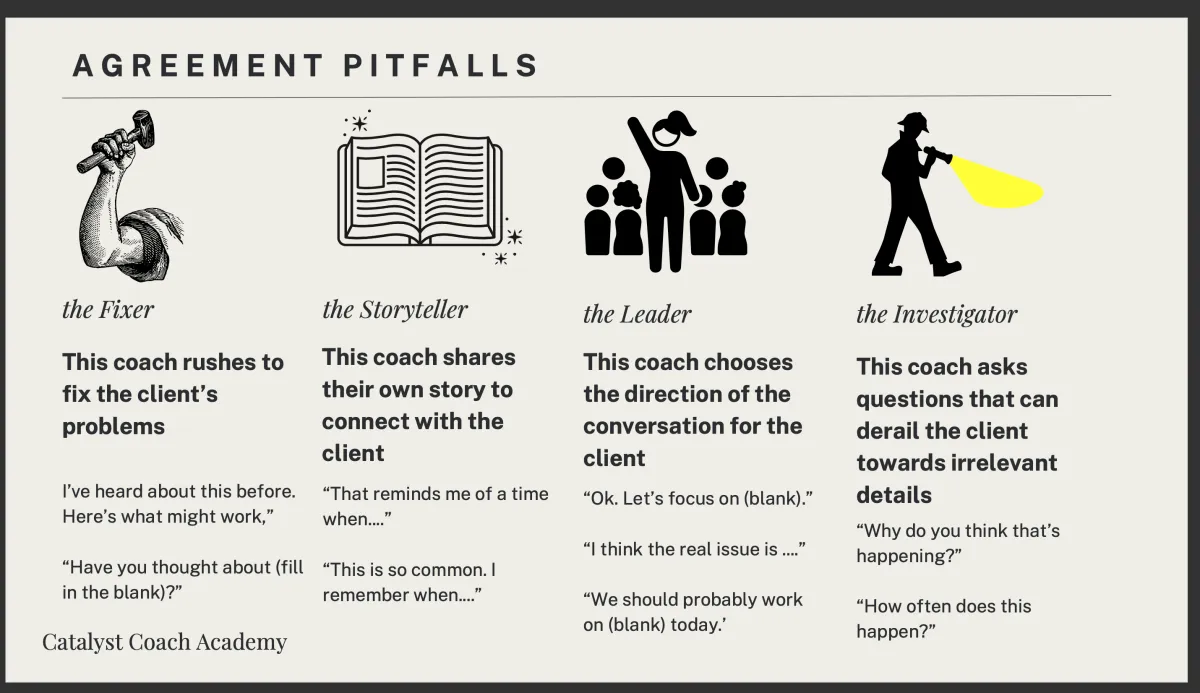
We named it. Actually, we named four of them. We call them the Coach Hijackers.
What a Hijacker Actually Is
A hijacker is not a bad habit. It is a good instinct showing up in the wrong context.
Every single one of them comes from a genuine desire to help. Every single one of them feels like the right move in the moment. And every single one of them quietly takes the wheel away from the client at the exact moment the client needs to be driving.
That is what makes them so hard to catch without training. You are not doing something “wrong.” You are doing something familiar in a place where it does not belong.
Here are the four.
The Four Coach Hijackers New Coaches Need to Recognize
1. The Fixer
“I have heard about this before. Here is what might work...”
The Fixer is the most common hijacker we see, and it shows up almost exclusively in people who were very good at their previous careers. Leaders. Consultants. Therapists. Teachers. People who built their professional identity around having useful answers.
Coaching breaks that identity open in an uncomfortable way. A client sits down with a problem you have seen a hundred times, and the answer is right there. You know what they should do. And you genuinely believe saying it will help them.
Here is what you are actually communicating when you do: I do not trust you to figure this out.
The client rarely hears it consciously. But they feel it. And something in the conversation closes down. Their sense of agency shrinks. The session becomes about your ideas instead of their capacity.
“Coaching is not about having the right answers. It is about creating the conditions where the client discovers their own.”
The work of moving past the Fixer is not about suppressing your intelligence. It is about redirecting it. Instead of thinking, What is the answer here? you start thinking, What question would help them find their own answer? That shift takes longer than most new coaches expect. But it changes everything.
2. The Storyteller
“That reminds me of a time when...”
This one feels like empathy. It feels like connection. You have been where the client is, and sharing that feels like a bridge between you.
The problem is that the moment you say, That reminds me of a time when..., the client’s brain makes a quiet pivot. They stop exploring their own experience and start listening to yours. The spotlight moves. And getting it back is harder than it sounds.
The coaching relationship lives in the client’s world, not the coach’s. Your experience is not irrelevant, but it belongs outside the session. The Storyteller sneaks in because it is one of the most natural human responses to someone sharing something difficult. We share back. We normalize. We connect through common ground.
In most contexts that is a beautiful thing. In a coaching conversation it is a detour the client did not ask for.
The most powerful sentence you can offer instead of a story is often: “Say more.”
3. The Leader
“I think the real issue is...” / “Let us focus on this today.”
This one is subtle enough that experienced coaches still catch themselves doing it years in.
The Leader sounds like insight. It sounds like the coach is earning their keep, cutting through the noise, naming the thing underneath the thing. And sometimes the coach is right. They probably are seeing something real.
But they have just made a decision that belonged to the client.
One of the core ICF competencies is honoring the client’s agenda. Not the coach’s read of the client’s agenda. Not the more interesting version of the client’s agenda. The actual agenda the client walked in with. To do this well, it helps to have a solid grasp of the ICF Core Competencies.
When in doubt, ask: “What would make this conversation most valuable for you today?”
Following someone else’s thread when you can see a different one takes a specific kind of discipline. You are not suppressing your insight. You are timing it. You are learning to ask instead of declare. And the conversations that come out of that discipline are consistently richer than the ones where the coach leads.
4. The Investigator
“Why do you think that is happening?” / “How often does this happen?”
This one is tricky because asking questions is supposed to be the job.
The Investigator asks questions that serve the coach’s curiosity rather than the client’s awareness. Why do you think that is happening? sends the client backward into analysis. How often does this happen? chases a data point that rarely leads anywhere useful. The client dutifully answers and the conversation moves further from the thing that actually matters.
The distinction between a question that opens and a question that derails is one of the most important things a new coach learns. It is not about question structure. It is about direction. Where does this question point the client? Toward their own clarity, or toward the coach’s need to understand the situation better?
Powerful coaching questions move the client forward in the moment; they do not send them backward to justify the past.
Those are two very different destinations.
What Changes When You Name These Patterns
When we introduce the hijackers early in our cohorts at Catalyst Coach Academy, something shifts quickly. Coaches go from a vague sense that something went sideways to specific, real-time self-awareness: I went into Fixer mode around minute seven. I felt it while it was happening.
That specificity matters more than most people realize. Vague self-criticism does not produce change. Specific observation does. And you cannot observe something you have never seen clearly before.
You cannot grow past something you cannot name.
The hijackers are not a reason to be hard on yourself. They are a map. And maps are useful precisely because they show you where you are, not just where you want to go.
If You Are Considering Coach Training
Every great coach has a primary hijacker. The one they default to under pressure. The one that feels so natural they would never catch it without someone pointing it out.
Finding yours is not a painful experience. It is actually one of the most freeing moments in early coach development. Because once you can see it, you have a choice. And having a choice is where real coaching begins.
If you are exploring what it means to become a certified coach, the question worth asking any training program is not just, What do you teach? It is, How do you help me see myself clearly enough to actually change?
That is the difference between earning an ICF credential and becoming a coach. For many coaches, the journey begins with ICF coach training that is designed to rewire old habits, not just teach new tools.
Explore Coaching Certification with Catalyst Coach Academy
At Catalyst Coach Academy, we design our coach training and ICF credential programs around this kind of deep, practical self-awareness. Yes, you will learn the competencies, frameworks, and ethics of professional coaching. But more importantly, you will learn to notice—in real time—when a hijacker is taking over and how to return the session to the client’s agenda with confidence and ease.
If you are a professional exploring becoming a certified coach, or an early-stage coach in an ICF training program who wants to elevate your practice, we would invite you to take the next step. Many new coaches aim for the ACC credential as a first milestone on that journey.
FAQ: Common Mistakes New Coaches Make
What is the most common mistake new coaches make?
The most common mistake is slipping into problem-solving instead of coaching. New coaches often feel pressure to prove their value by offering answers, advice, or frameworks. It feels helpful, but it quietly takes the focus away from the client’s thinking, awareness, and ownership of the outcome.
How do I stop giving advice in a coaching session?
Start by noticing the moment you feel the urge to jump in with a solution. Instead of speaking, pause and turn your advice into a question that points the client back to their own resourcefulness. With practice, your default shifts from “What should they do?” to “What would help them think more clearly right now?”
How long does it take to break old habits in coach training?
Most coaches start to notice real shifts within a few months of consistent practice, feedback, and supervision. Deeply ingrained habits—like fixing, leading, or over-questioning—can take longer to unwind, but structured ICF coach training accelerates that process by giving you language, tools, and targeted support.
What is the difference between coaching and consulting?
Consulting is built around expertise and recommendations—the consultant analyzes the problem and tells the client what to do. Coaching, by contrast, is built around partnership and inquiry. The coach holds space, asks powerful questions, and supports the client to create their own insights, decisions, and next steps.
- Learn more about our coaching certification pathways and how they align with your career.
- Talk with a member of our team about your goals and which coach training track fits best.
- Experience a live session or sample class to see how we work with the Coach Hijackers in real time.
